
Rabat was supposed to be nothing more than a place to spend the night on my way to Marrakech. A few hours later, I was standing in the blue-and-white lanes of the kasbah, looking out towards the Atlantic, and realising I’d found my own little pearl of Morocco.
Had anyone asked me before that trip which three Moroccan cities I most wanted to see, Rabat probably wouldn’t have made the list. Fes was there for its medina, Marrakech was more or less a given, and I had no particular ambitions where Rabat was concerned. It found its way into my itinerary for an entirely practical reason: the train from Fes to Marrakech takes almost seven hours. Not that I had anything against Moroccan trains — I hadn’t even tried them yet — but seven hours in a seat seemed a bit excessive. So I looked at the map, divided the journey in two, and found a city that fitted my requirements perfectly. For a night’s sleep, naturally.
At the station in Fes, my first Moroccan train journey was waiting for me. Buying the ticket was straightforward. The clerk spoke enough English, which was already encouraging given that my Arabic and French can be summed up in very few words: I speak practically none. The signs were another matter. Fortunately, staff were on hand to help passengers, so with a little English and quite a lot of pointing, I found my platform. Fes station, at least, is nothing like the size of Rome’s Termini. Had it been, my Moroccan railway adventure might have begun rather less gracefully.

I bought a first-class ticket. The price difference was small, and Morocco was still unfamiliar enough for me to have a few reservations about travelling on my own. Not many, and as it turned out, mostly unfounded. But when a small supplement can eliminate at least one uncertainty, I see no reason to put on a show of bravery. Besides, I’ve never believed that travelling solo should automatically mean doing without a little comfort.
As soon as the train pulled away, my caution began to look rather unnecessary. I settled in, watched the scenery go by and let it do the entertaining. That’s what I love about trains: between two cities, you have time to notice how a country changes. It didn’t feel as though I was merely covering a distance on a map. I was slowly discovering another part of Morocco. And Rabat, according to my plan at least, was simply where I’d break the journey.
The Hotel That, for Once, Wasn’t the Main Attraction
I arrived in Rabat in late December 2018 with one afternoon and one night to spare. I can be quite particular about hotels. Sometimes I’m almost as interested in the hotel itself as in the city around it, which isn’t always the most sensible approach to sightseeing. In Rabat, though, I’d decided to exercise some discipline. I wanted somewhere pleasant, conveniently located and unlikely to tempt me into spending the rest of the day in a hotel bar, swimming pool or attractively furnished lounge.
The idea was to walk from Rabat Ville station to the hotel, and preferably around most of the city as well. I wasn’t particularly keen to spend my first day in an unfamiliar Moroccan city working out the taxis, nor did I intend to study the public transport system in any depth. Le Diwan, part of Accor’s MGallery collection, looked exactly right on the map. Good enough and close enough to everything. In theory, a beautifully simple choice. Simplicity, it turned out, would come with a few complications.

A Police Welcome and One Very Expensive Megabyte
The walk from the station to the hotel was supposed to take about ten minutes. Somewhere along that short route, however, I apparently managed a remarkably convincing impression of a man with absolutely no idea where he was going. A police officer approached me of his own accord and offered to help. I told him where I was staying, and with a combination of words, gestures and patience, he explained which way to go. Just to be safe, he pointed me in the right direction once more. Then he smiled and wished me a pleasant stay.
It wasn’t the only time on that trip that the Moroccan police struck me as a kind of unofficial tourist information service. They were friendly, approachable and often far more helpful than I’d have expected from officers who surely had better things to do. Admittedly, what they had in front of them was a tourist with a suitcase. I imagine I might have seen a more serious side of their work under different circumstances.
The question remains: how does a man who often travels alone and holds a degree in computer science and a doctorate in mathematics manage to get lost just a few minutes from a railway station? Especially in an age when Google Maps knows almost everything about every corner of the planet.
The answer, as it turned out, cost around €12.44 per megabyte.
My phone connected to the Moroccan network perfectly well. Google Maps worked too. Unfortunately, my Croatian operator’s data-roaming rates at the time weren’t exactly an invitation to wander about with navigation switched on. So instead of a technologically flawless arrival at the hotel, I had a very pleasant conversation with a Moroccan police officer. And I got off lightly, considering what a few minutes of navigation would have cost me.
Le Diwan in Rabat: Plenty of Promises, Not Much Delivery
My story with Le Diwan had actually begun three days before I arrived. The hotel contacted me on WhatsApp, asking whether I had any wishes or special requests. A nice touch. I thanked them and said I didn’t need anything for the moment. They then checked again to make sure I really didn’t need a thing. After that level of persistence, it would almost have been rude not to think of something.
The following evening, I sent them a short list. Could they arrange a private tour of Rabat, leave a set of bathroom scales in my room and confirm the distance from the railway station? Two reminders later, a reply arrived: they could arrange a guide, I’d learn the price at reception, the scales would be waiting in my room, and Rabat Ville was about a ten-minute walk away. Everything appeared to be running smoothly. I was almost surprised at how much attention they were paying to a guest staying for just one night.
On the morning of my journey, I sent one final message to say I’d be offline until I arrived, and asked whether they could provide a shaving kit. That message went unanswered.
When I finally reached the hotel, I began to realise that their enthusiastic WhatsApp welcome involved a rather flexible interpretation of the word delivery. Nobody at reception knew anything about a private guide. There were no scales in my room. No water either, which I wasn’t thrilled about, although at least I could ask for that in person. Even then, it took another two or three reminders.
The crowning moment came the following day, at checkout. Reception finally handed me a bottle of water and a small can of shaving foam, precisely when I no longer had much use for either. I couldn’t shake the feeling that they fully intended to honour every promise; checkout time had simply caught them by surprise.
I opened WhatsApp and wrote: “I have checked out. Thank you for not providing the scale, the water or anything else.”
An apology arrived that evening, together with a promise that next time everything would be exactly as I wanted. I have to admit, it made me laugh. We’d managed to build up quite a correspondence over a single stay, and the hotel had neatly transferred all its unfulfilled obligations to some hypothetical future booking. If the idea was to encourage me to return, it was certainly an original approach.
The Symmetry That Changed My Plans

My introduction to Rabat began at the Mausoleum of Mohammed V and the nearby Hassan Tower. I knew a little about the complex and had seen photographs, but I’d never attached any particular importance to it.
Then I walked up to the tower and was speechless. Not something that happens to me every day.
Even now, when I try to explain why it impressed me so much, no single detail seems enough. On one side stood the massive Hassan Tower; on the other, the Mausoleum of Mohammed V. Between them stretched rows of stone columns laid out with astonishing precision. I walked among them, doubled back, turned towards one end of the site and then the other. For someone with a weakness for symmetry, geometry and monumental architecture, it was hard to imagine a better combination.
My photographs captured the order of the composition but not its true scale. I’m still not sure I can put that into words. I was looking at something that had remained unfinished for centuries yet somehow felt complete precisely because of what had survived.

Hassan Tower is a vast stone prism, the unfinished minaret of a mosque conceived by the Almohad ruler Yaqub al-Mansur in the late twelfth century. In Meknes, I had already seen just how ambitious Moulay Ismail could be. Here was another ruler’s grand design, except that this time the absence of the finished building had become the main attraction. On its own, the tower would look like a completed monument. Only the surrounding walls and rows of columns reveal how enormous the mosque was meant to be.

Across the esplanade stood the mausoleum, an entirely different sort of monumentality: lavish mosaics, meticulously crafted ornament, royal guards and a ceremonial solemnity. Although it is a tomb, I remember it as peaceful rather than sombre. You could sense how deeply Moroccans respect Mohammed V, the ruler buried there.
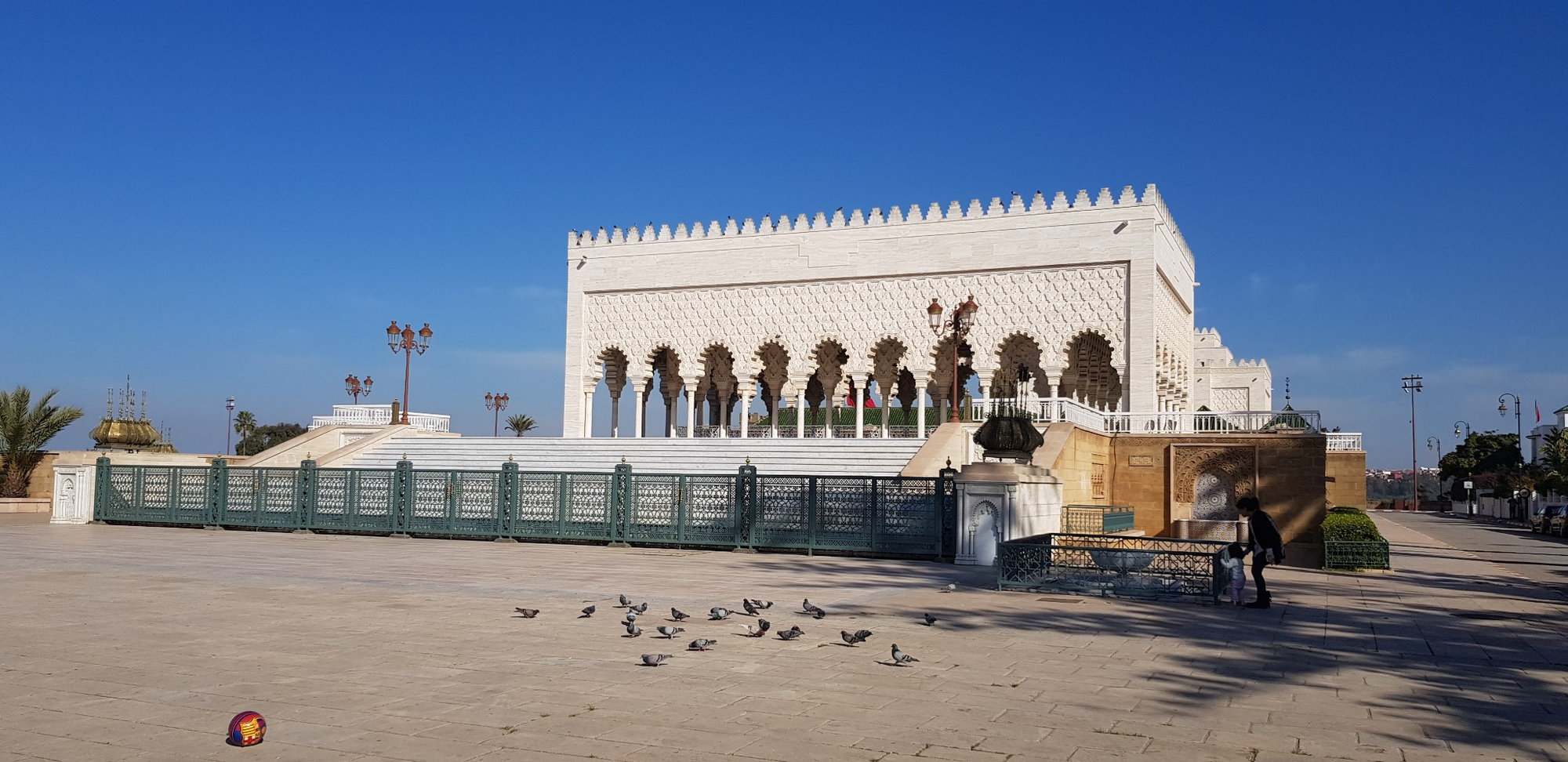
That was the first moment I seriously began to question my itinerary. I’d chosen Rabat because of where it sat on a railway map. Now I had a feeling I’d found one of the places I’d remember longest from Morocco. And I’d barely begun exploring.
A Medina Where I Could Finally Just Look
After Hassan Tower, I headed towards the Kasbah of the Udayas, passing through the souks — the shopping streets of the medina. Coming from Fes, I was ready for anything: crowds, traders, invitations to inspect shops and attempts to convince me I was going the wrong way. None of it was exactly new to me, but sometimes I simply wanted to observe a city without being drawn into an endless round of commercial negotiations.
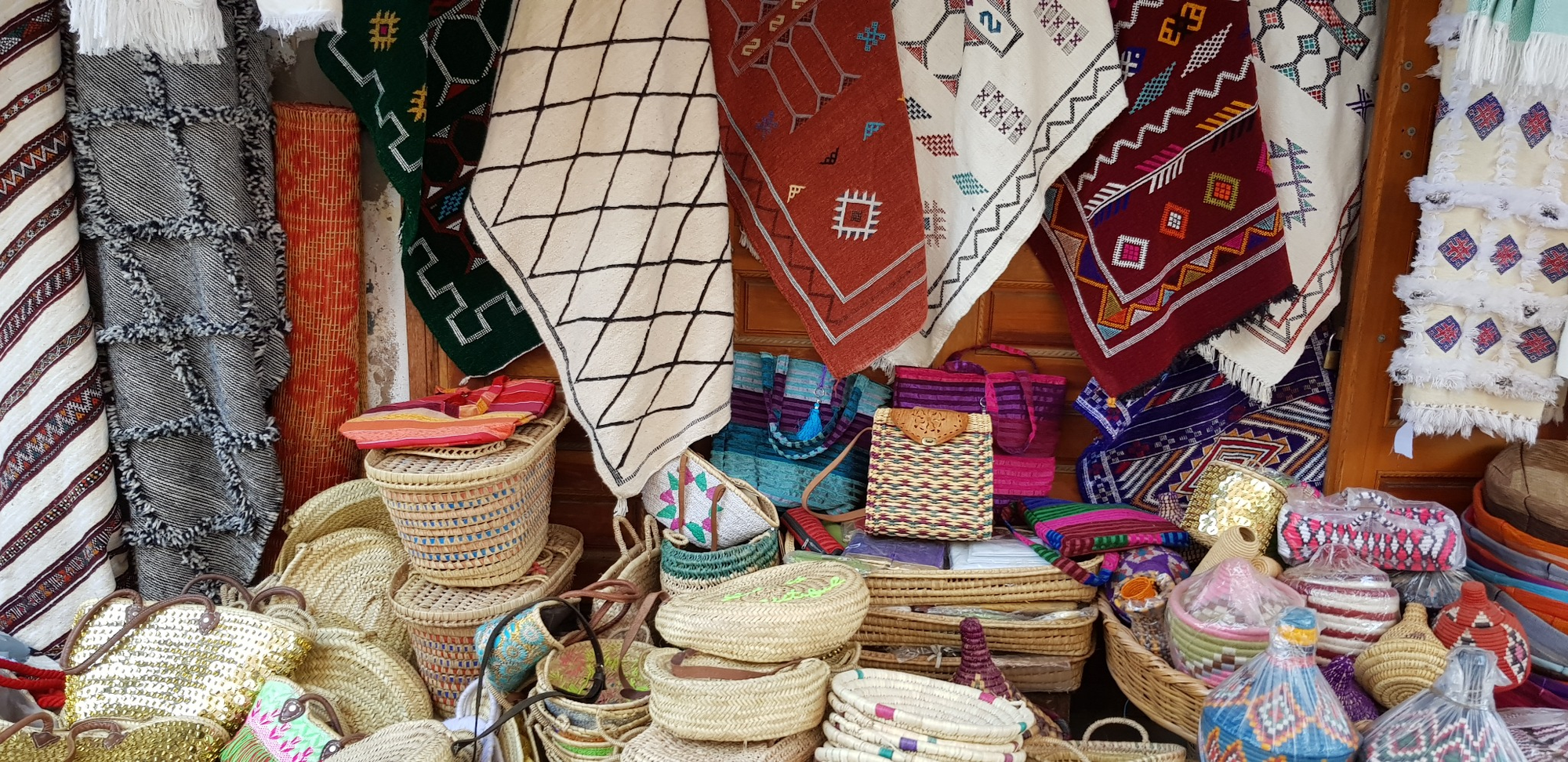
Here Rabat pleasantly surprised me. In the medina’s craft quarter I came across pottery, leather goods, fabrics and all manner of handmade things, much as in Fes, but here the streets seemed tidier, more colourful and somehow airier. The stalls were full of things I wanted to look at. More importantly, I could look for as long as I pleased.
The shopkeepers hadn’t disappeared. It was simply that nobody tugged at my sleeve, pressed me to enter a shop or tried to foist a guide on me. I could stop, examine what was on display and carry on. After Fes, that sort of freedom felt almost luxurious.

Still, it would be an exaggeration to say the medina itself impressed me as much as the one in Fes. It is smaller and more orderly, and after the maze of lanes in Fes it felt almost modest. Had I come to Rabat first, I’d probably have seen it differently. As things were, what won me over wasn’t so much the place itself as the fact that I could explore it in peace.
So I wandered slowly through the medina, with no particular destination beyond the kasbah waiting at the far end. There was no hurry, and taking photographs could finally matter more than fending off offers I had no intention of accepting.
The Kasbah, Blue Streets and the Atlantic: Now This I Hadn’t Expected
To be honest, after Hassan Tower I thought Rabat had already shown me its best. I’d seen something magnificent, taken a ridiculous number of photographs and felt thoroughly pleased with my decision to spend the night here. Now, I assumed, all that remained was another pleasant walk around the old town.
Then I emerged from the medina and nearly fell over.
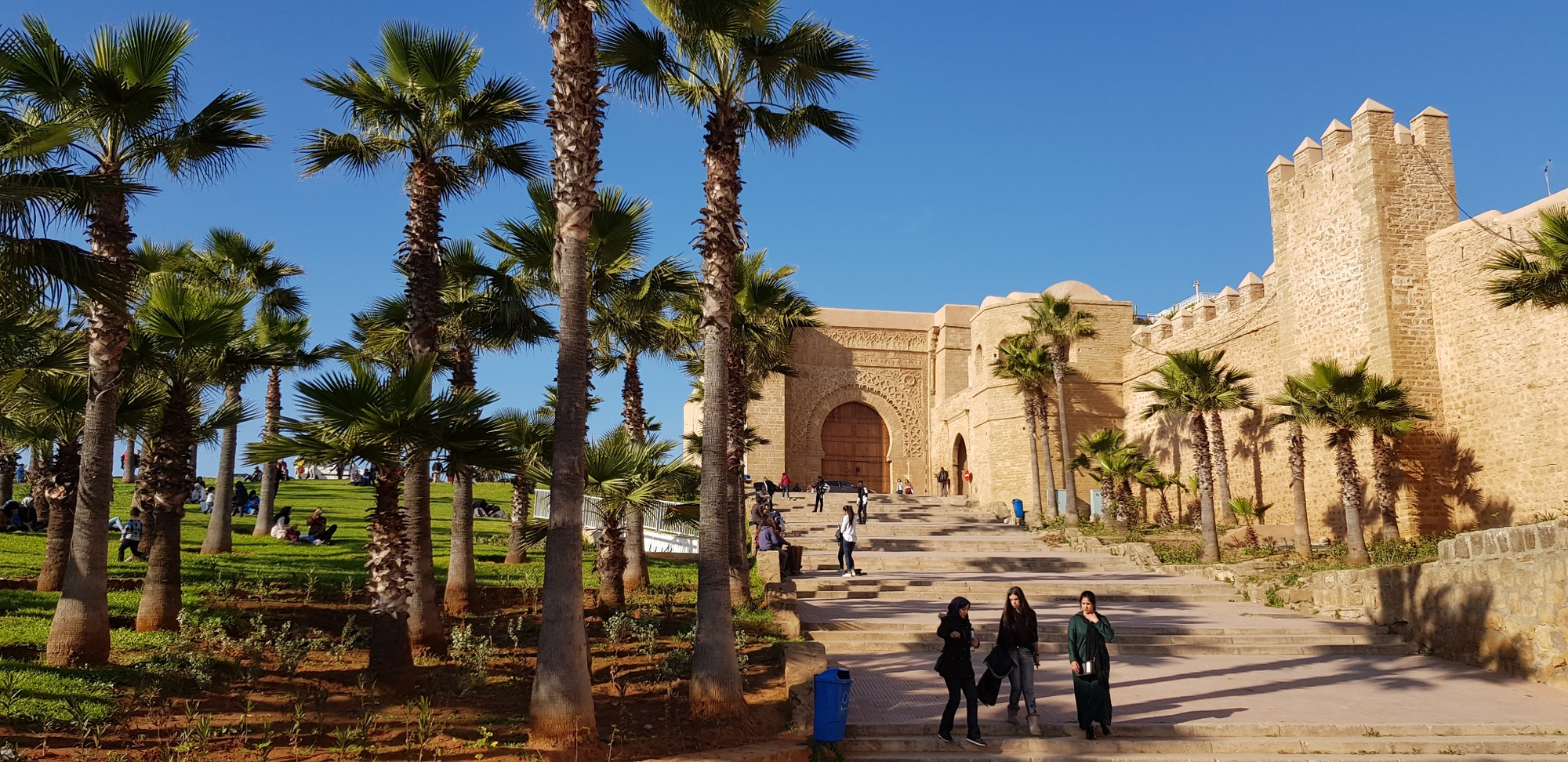
Rising before me were the massive walls of the Kasbah of the Udayas (Kasbah des Oudaias), the old fortified quarter above the mouth of the Bou Regreg. Sand-coloured stone, an enormous and richly decorated Almohad gate, broad steps and palm trees beside the ramparts. Some people sat on the grass below, others climbed the steps, and above it all stretched a perfectly clear blue sky. I stood there feeling as though I’d wandered into an illustration from a fairy tale about flying carpets. After everything I’d seen in Morocco over the previous few days, I thought I had a reasonable idea of what the country could surprise me with. Evidently, I’d overestimated myself.
Before I’d had quite enough time to admire the walls, I was already in the Andalusian Gardens. Palm trees, orange trees, bougainvillea, water and pathways threading through the greenery created an atmosphere quite unlike the one outside the entrance. Nearby stood a pavilion dating from the time of Moulay Ismail, in the late seventeenth century. Only later did I learn that the gardens themselves had been laid out in the early twentieth century, during the French Protectorate, in a Hispano-Moorish style. Their name and appearance had suggested a much older history to me. I was completely wrong, but at least this time I had a beautiful reason for being wrong.
From the gardens, I entered narrow stone lanes, climbed shallow steps and followed turns that opened onto a new scene every few metres. The houses were white, with the lower halves of their façades painted a vivid blue; doors and windows followed the same palette. A lamp hung above one passageway, while sharp shadows cut across the white walls. After the earthy tones of the Moroccan cities I’d visited so far, the combination looked almost unreal.
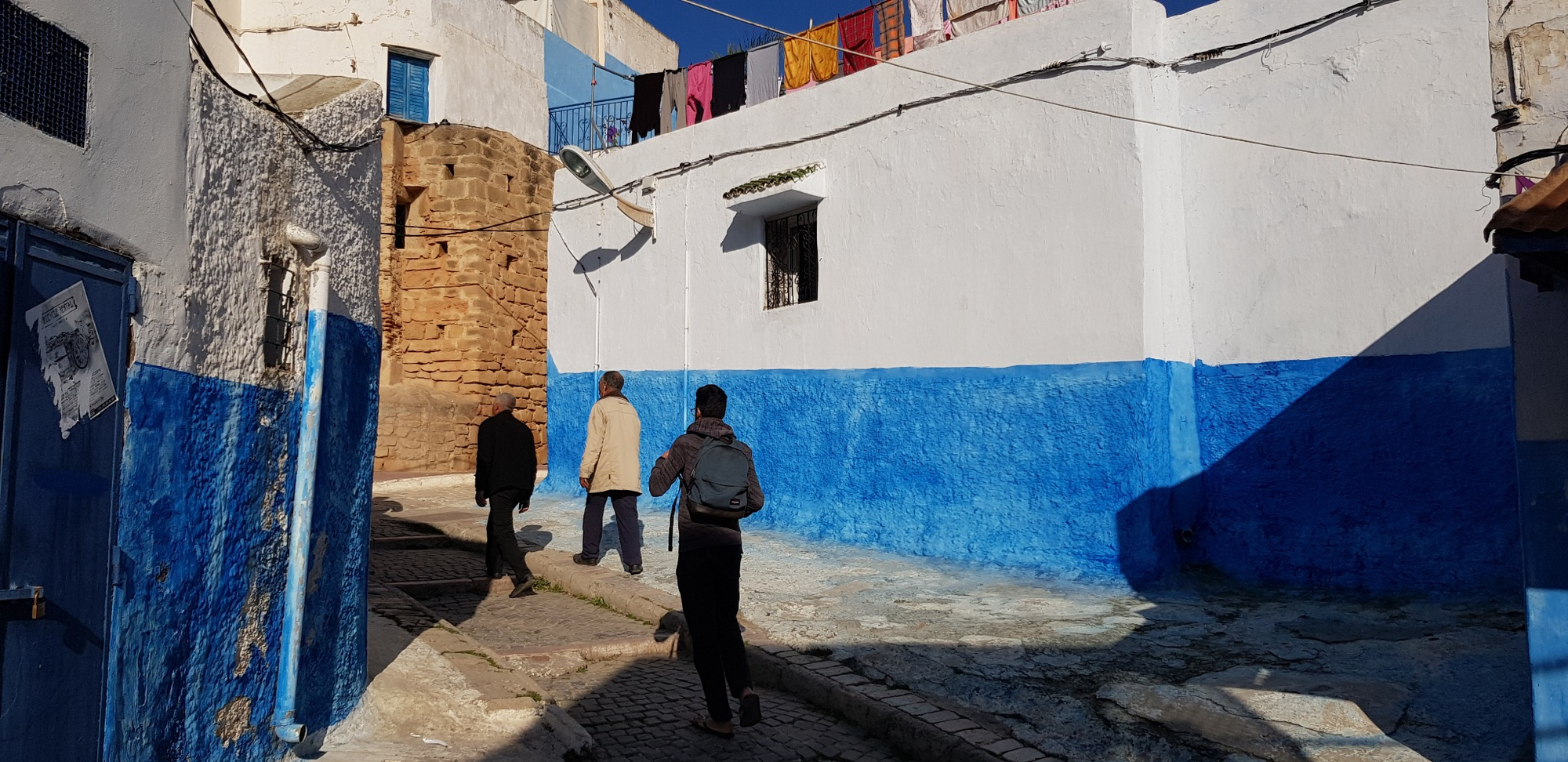
I still can’t decide what impressed me more: the monumental walls seen from outside, or the quiet blue-and-white passages between the houses. Either way, my camera had plenty to do. I wasn’t hunting for a particular street recommended in a guidebook. Every other corner looked like a photograph I’d regret not taking. And what captivated me wasn’t simply the familiar blue-and-white colour scheme. It was the regularity of those colours — and the way doors, steps and shadows constantly disrupted it.
Then the houses parted, and suddenly I was standing on a terrace above the ocean.
To one side lay the mouth of the Bou Regreg, with Salé across the river; straight ahead was the Atlantic. Below the terrace were a beach, a crenellated stone wall and a breakwater curving far out into the sea. The people walking along it looked tiny. My gaze travelled beyond them, towards the open water and the horizon. Once again, I was lost for words. The Morocco I’d imagined before the trip simply hadn’t included a view like this.
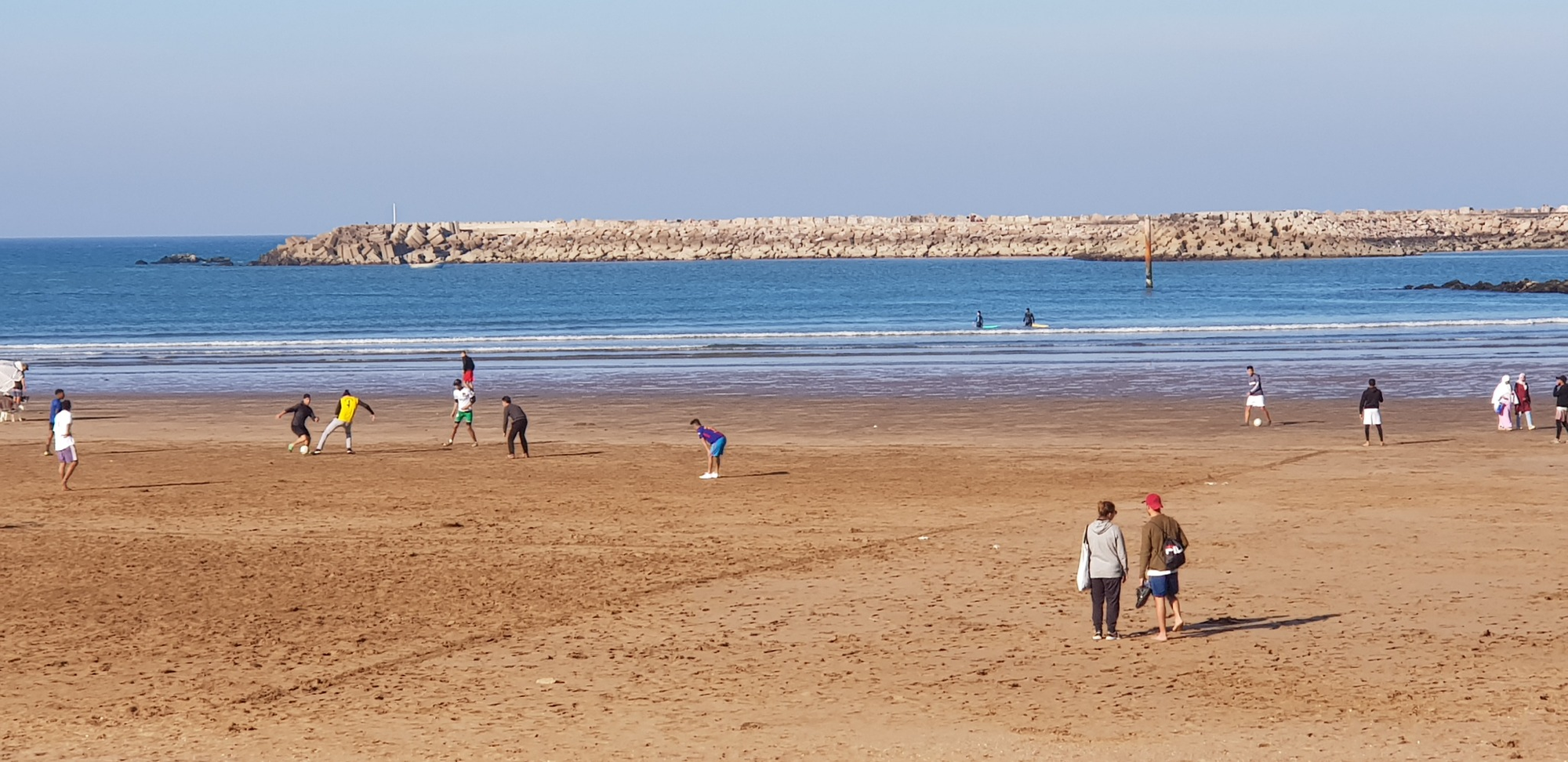
I went down to the beach. It was the day before New Year’s Eve, yet white parasols still stood in the sand. Barefoot young men chased a football, others strolled, a few couples talked, and some people seemed to have come simply to spend a little time by themselves. Footprints marked the sand and small waves rolled in along the shore. There were enough people for the beach to feel alive, yet enough space for you to feel almost alone. For the end of December, it struck me as a very appealing way to spend an afternoon.
From there I continued towards the breakwater. I could now look back at the kasbah from the other side: the walls rising above the sand, and behind them the houses I’d been wandering among with my camera only moments earlier. Farther along, the coastline grew more rugged, with broad, algae-fringed rocks emerging from the water. I followed the old walls all the way to the lighthouse. Nearly an hour had passed since I’d first stepped onto the terrace, and Rabat was still finding ways to surprise me.
In a single afternoon, I’d found a medieval fortress, something close to Andalusian exuberance and a thoroughly convincing stretch of Atlantic coastline.
Camel Heads, Three Glasses and the Limits of My Cultural Adaptability
I returned from the Atlantic to the medina. Curiously, this time I found myself in a very different part of it. After the neat craft streets, this part suddenly felt like Fes all over again: denser, louder and, if I had to choose a word, considerably less polished.
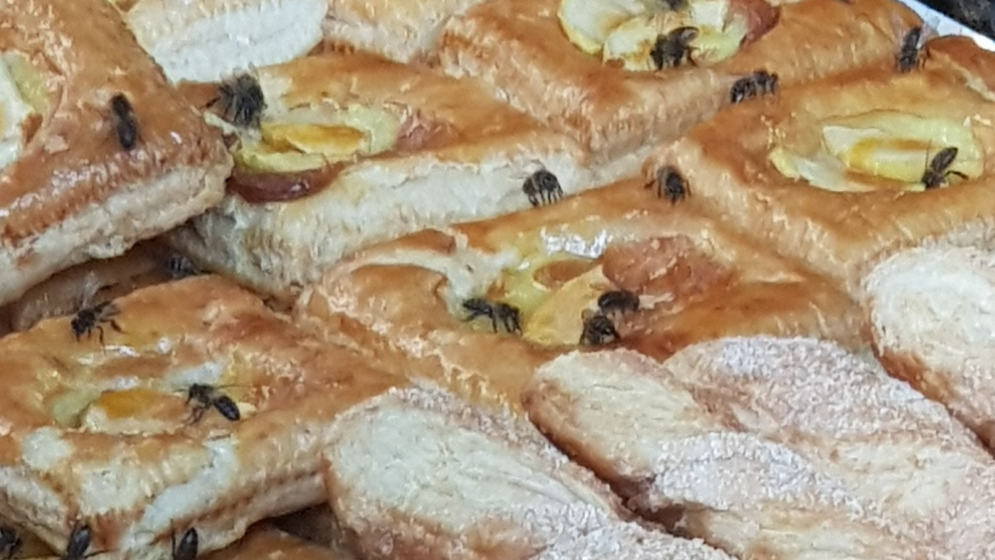
At one point I ended up among food stalls. Even after several days in Morocco, some of what was on offer was still far from everyday fare for me. Offal whose origins I couldn’t always identify, camel heads, all sorts of meat dishes, snails, fruit, vegetables and cakes. The cakes seemed particularly popular with the bees. They swarmed over them undisturbed, as though the bees were a perfectly normal sort of decoration. Nobody appeared especially bothered.
What interested me most, however, was an elderly mint-tea seller. He had three glasses. Three. A customer would finish his tea, hand back the glass, and the seller would fill it for the next person. No washing between customers, at least as far as I could see. I watched the whole process, trying to decide whether there was some clever system I was missing or simply a different idea of hygiene.
By the time I reached Rabat, I’d grown used to quite a few things that had startled me during my first days in Morocco. A camel’s head on a butcher’s stall was no longer enough to shock me. But getting used to looking at something and deciding to take part in it are two entirely different matters.
I didn’t drink tea from any of the three glasses. Nor did the bee-covered cakes inspire an overwhelming desire for a tasting session. I stuck to taking pictures. I can accept that people have different eating habits and standards of hygiene without feeling obliged to try every single one of them just to prove what an open-minded traveller I am.
Besides, scenes like these were exactly what I found fascinating. I’d have been a little sorry if, after just a few days in Morocco, I’d stopped noticing how different its everyday life could be from my own.
A Modern Capital and a King I Couldn’t Get Near
Leaving the medina, I followed Avenue Mohammed V through the ville nouvelle, Rabat’s newer, planned city from the French Protectorate era. Broad avenues, a more regular street plan, imposing façades and considerably more room than in the old town. After the kasbah, where every turn brought a fresh surprise, everything here felt orderly and, frankly, a little official.
None of it looked like scenery arranged for tourists. Well-kept parks and squares, hotels, restaurants and public transport gave the impression of a developed, well-organised capital. Within a few minutes of leaving the medina and kasbah, I felt as though I’d crossed from one Morocco into another.
Then the city buses came into view.
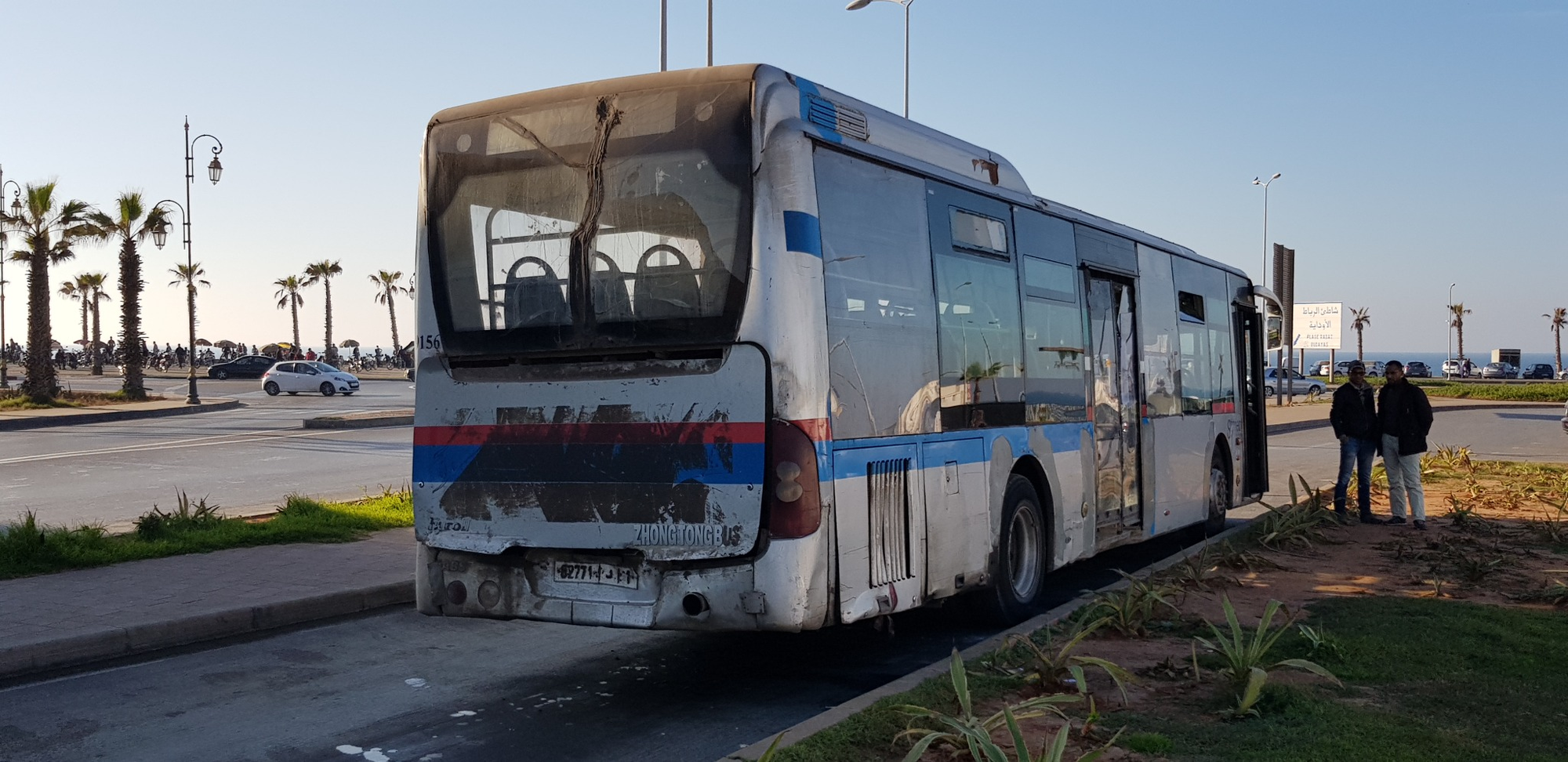
Blue and white, rather battered and clearly with a great many kilometres behind them, they looked as though they’d taken a wrong turn into a completely different city. I don’t know whether it was the buses themselves or their contrast with the tidy avenues that caught my attention more. In any case, I photographed several of them. When I travel, I often notice precisely the things a guidebook wouldn’t consider worth mentioning. Some people photograph palaces. I occasionally photograph the bus fleet alongside them.
By evening, the streetlights were on. Illuminated arcaded façades, a minaret glowing above a junction, cars and buses passing in front of them — it felt as though I was discovering the same city all over again, this time in a different light. There was still one thing left on my list: the Royal Palace.
The British royal family has apparently accustomed me to the idea that you can at least admire a royal residence from a respectable distance. In Rabat, I hoped to see something of the palace and royal life. I wasn’t expecting an audience, of course. A handsome gate, like the ones I’d seen in Fes, would have done nicely.
The Moroccan royal family had other plans for my curiosity.
The police stopped me very politely and indicated exactly how far I was allowed to go. The boundary was quite clear. In Fes, I’d at least seen the magnificent palace entrance; here, not even that. Once again I encountered the same courtesy from the Moroccan police that had greeted me on arrival. Only this time, instead of showing me where to go, they very politely informed me where I most definitely could not.
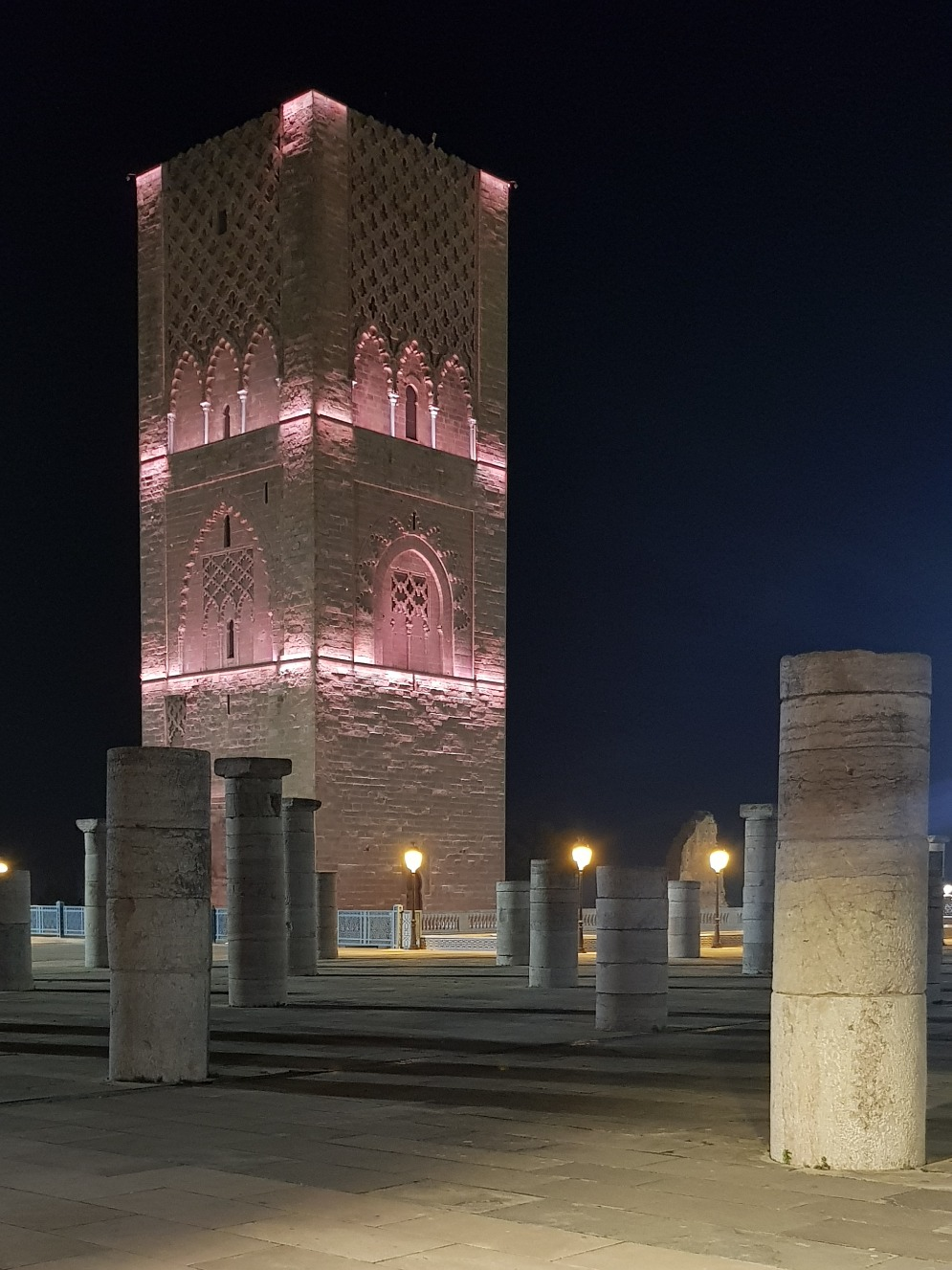
Shortly before eight, I returned to Hassan Tower and the Mausoleum of Mohammed V. The tower was now bathed in a warm, almost pink light, while the white mausoleum with its green roof stood out against the dark sky. Between them, the columns of the unfinished mosque emerged from the half-light. The same place that had amazed me with its symmetry during the day now had a different atmosphere altogether. I certainly wasn’t complaining. It meant I got to photograph it all over again.
As I finally headed back to the hotel, I tried to count how many different Rabats I’d encountered in just a few hours: the monumental complex, the orderly medina, the blue-and-white kasbah, the Atlantic, a market with camel heads, old buses and a closely guarded royal palace.
Tagine, Tea and Hotel Promises That Had to Wait Until Morning
After all that walking, I had no desire to go searching for restaurants. Particularly after what I’d seen at the market. The hotel kitchen suddenly seemed a perfectly reasonable compromise between immersing myself in Moroccan culture and protecting my digestive system.
There were international dishes on the menu, but I went for a beef tagine. If I was going to dine at the hotel, I could at least avoid ordering something I could just as easily eat at home. A tagine, incidentally, is both the dish and the conical-lidded earthenware pot in which it is cooked. Mine arrived with beef and vegetables, so hot that the waiter immediately warned me not to touch the pot. Given my experiences with the hotel’s promises, I have to admit it was nice to receive one useful piece of information on time.
The food was good, although I was still more fascinated by the preparation and the way it was served than by the taste itself. Moroccan main courses hadn’t entirely won me over on this trip, but at least this dinner came without any hygiene dilemmas.
Afterwards I moved to the bar and ordered mint tea. I’m not particularly fond of mint, but Moroccan tea was already growing on me. Probably because the quantity of sugar was more than enough to overcome any reservations I might have had about the plant. At the next table sat a group of rather drunk Germans, whose enthusiasm ensured the evening never became dull. I found it all entertaining. The staff, I suspect, were rather less delighted.
The following morning I was back at Rabat Ville station with a ticket to Marrakech. Belated water and shaving foam aside, I was already looking back on my stay very differently from how I’d imagined it.
Hassan Tower, the mausoleum, the kasbah, blue-and-white streets, a December beach on the Atlantic, old buses and, of course, a hotel whose promises apparently operated in a time zone of their own. All of that had fitted into one afternoon and one night.
I was leaving convinced that Rabat had given me one of my most memorable experiences in Morocco.
Standing on the platform, I no longer wondered why I’d included Rabat in my itinerary. I was wondering how on earth I’d ever imagined that one night would be enough.
For Those Who Want to Know More
Rabat is the capital of Morocco and one of the country’s four imperial cities, alongside Fes, Marrakech and Meknes. It became the capital in 1912, taking over that role from Fes under the French Protectorate. In 2012, UNESCO inscribed it on the World Heritage List as “Rabat, Modern Capital and Historic City: a Shared Heritage”. The protected area covers both the modern and the historic city: the ville nouvelle with its royal and administrative districts, as well as the medina, the Kasbah of the Udayas, the Almohad walls and gates, the Hassan complex and Chellah.
Hassan Tower is what remains of a far grander scheme. Construction of the enormous mosque began in the late twelfth century under the Almohad ruler Yaqub al-Mansur. Work stopped after his death in 1199, and the project was never completed. The tower, surviving walls and rows of stone columns are reminders of the monumental capital he had imagined.
On the other side of the esplanade stands the Mausoleum of Mohammed V, built between 1962 and 1971. It is the resting place of Mohammed V, one of the key figures in Morocco’s independence, and of his two sons, King Hassan II and Prince Moulay Abdallah. Mohammed V returned from exile in November 1955, and in March 1956 performed Friday prayers at the ruins of the Hassan Mosque before thousands of people. Independence from France followed in 1956, and in 1957 the former sultan adopted the title of king.
The Kasbah of the Udayas occupies a strategic position above the mouth of the Bou Regreg. Its oldest monumental features date to the Almohad period, while later Andalusian influence left a strong mark on it.
Today, the blue-and-white streets are one of the Udayas’ most recognisable visual signatures. There are several explanations for how that particular colour combination became so characteristic, but none is documented solidly enough for me to present it here as an established fact. Whatever its origin, the result speaks for itself.
The Bou Regreg is the river that meets the Atlantic here, separating Rabat from Salé on the opposite bank. For centuries, this location gave the kasbah strategic importance. Today, it gives visitors one of the finest views in the city: the river below, Salé across the water and the Atlantic straight ahead.
One important place was missing from my walk: Chellah. Here, traces of a pre-Roman settlement overlap with the Roman city of Sala Colonia and a Marinid necropolis dating from the thirteenth and fourteenth centuries. Chellah also forms part of Rabat’s UNESCO-listed heritage. Put all these layers together and it becomes easier to understand why, within just a few kilometres, Rabat can feel as though it belongs to several different centuries.

