Seven Hotels in Lisbon — From a Palace to an ibis
Published on September 16, 2026 • 21 min read
Nine years, seven hotels in Lisbon, and everything that happened between them.
Some cities I remember through their streets, others through people, and still others through a single evening or one particular view. Lisbon, apparently, I remember through hotels.
I first arrived in 2015 and stayed in a hotel recommended by the conference I was attending. The last time, nine years later, I chose a hotel practically attached to a railway station because I was continuing to Porto the next morning anyway. Between those two stays came five more hotels, several conferences, a trip to Morocco, a return from Morocco, and one project budget with very firm opinions about my hotel ambitions. Lisbon, meanwhile, was slightly different every time.
I never deliberately set out to try seven hotels in the same city. Well, in 2017 I did, but the rest simply happened. Looking back at them in chronological order, those seven hotel rooms tell the story of my visits to Lisbon better than the itineraries do.
2015 — Avenida Park: perfectly adequate for a first visit
My first Lisbon began in a very conventional way. I was there for a conference, and one of the recommended places to stay was the Avenida Park Hotel. I did not know the city, the hotel had three stars, the price was reasonable, and I had no particular reason to reinvent the wheel, so I booked what the conference suggested.
The hotel was exactly what you would expect from that sort of choice: clean, decent and without any remarkable surprises in either direction. It is not the kind of place that becomes legendary ten years later, but it also gave me no reason to remember it badly.
Its greatest advantage was the location. The hotel sits right by Parque Eduardo VII, a few minutes from Parque metro station, while Marquês de Pombal is close enough that you more or less just walk downhill to reach it. The hop-on hop-off buses also departed from there, which was useful on a first visit to the city. You could walk to the historic centre as well; it required a little effort, but sooner or later Lisbon has to be explored on foot.
Would I choose it again today? Probably not, unless I had a very practical reason to do so. Not because anything was wrong with it, but because somewhere along the way I realised that a hotel can be part of the journey rather than simply the place where the journey stops overnight. At other times a hotel can take over the story completely, as happened to me in Bournemouth and the Hotel That Understood Everything. Avenida Park did not. For my first Lisbon, though, it did its job perfectly.
2017 — Three hotels in Lisbon, three versions of luxury
Two years later, the situation was very different. I was paying for the accommodation myself rather than from a project budget, which paradoxically gave me more freedom: if I was spending my own money, I could at least decide what I wanted to spend it on. And that time I deliberately decided to test Lisbon’s hotel scene a little.
It was a transitional period after Marriott’s acquisition of Starwood in 2016. The loyalty benefits were good, but the choice of really well-located hotels in central Lisbon within the Marriott–SPG universe, as I remember it, was not particularly broad. Fontecruz on Avenida da Liberdade was the obvious option, the Sheraton was a little further out, Lisbon Marriott further still, and if you widened the search radius too much you were already drifting towards Cascais.
Then Booking showed me something much more entertaining: Altis Avenida, five stars, for under one hundred euros a night. You do not say no to that.
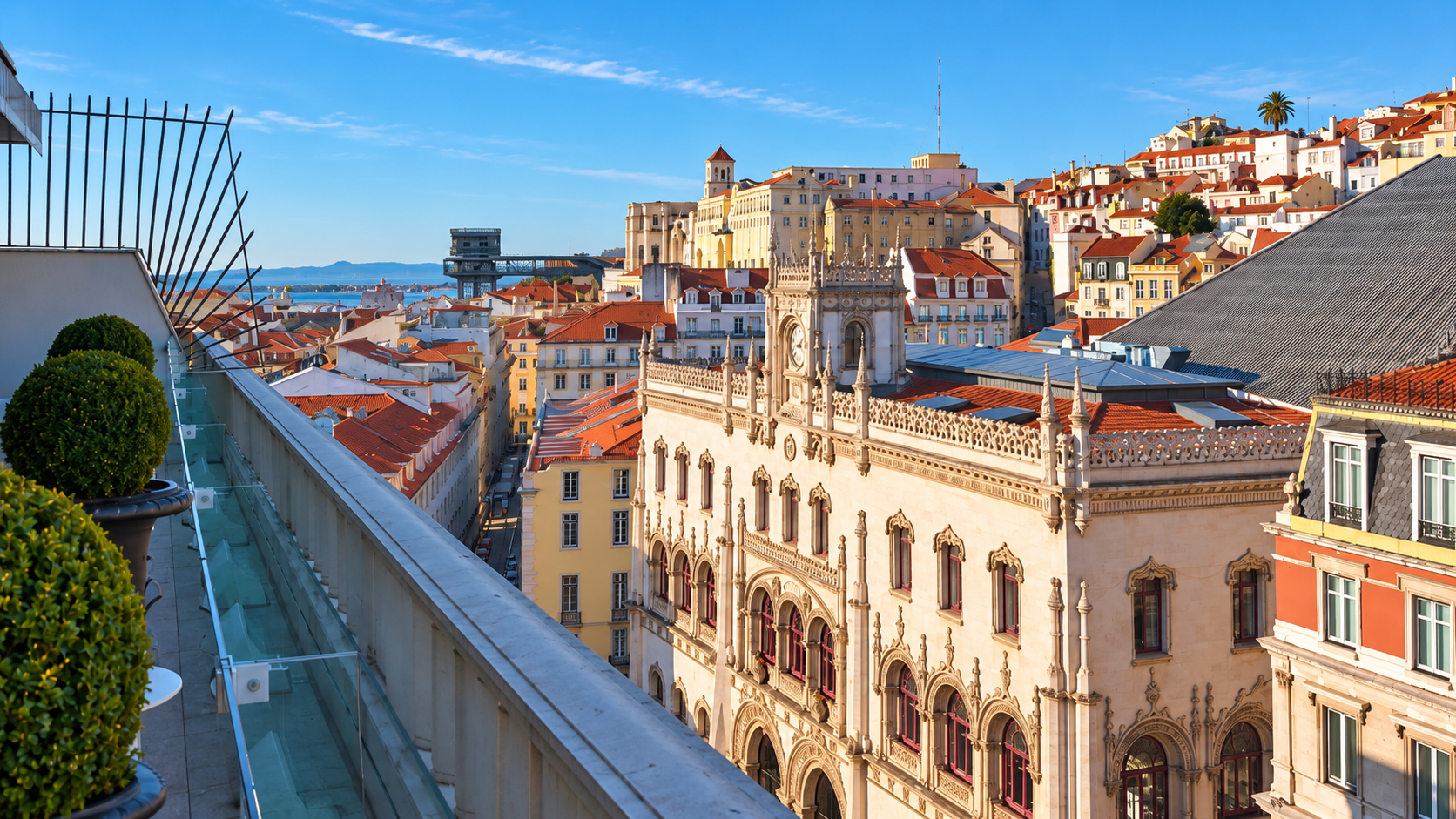
Altis occupies an almost perfect spot between Restauradores and Rossio; you do not leave the hotel and head towards the centre — you are already in it.
What I remember most clearly is breakfast on the rooftop. Straight ahead, the view opened towards the Tagus; Alfama lay to the left and Bairro Alto to the right, and the whole scene carried an almost excessive sense of elegance. I remember feeling expensive up there. Not well located, not pampered — expensive.
Somewhere nearby I also found a shoe shop with styles unlike anything I usually saw back home, so I stocked up a little. When I returned to the hotel carrying the bags, the doorman took them from me and had them sent up to my room while I carried on sightseeing, as if that were the most normal thing in the world. It was not, at least not to me then. For a moment, the whole thing felt cinematic.
For a five-star hotel in that location, under one hundred euros was indecently cheap. And then Booking did something even better: for the following night I found Avenida Palace, again five stars, again for under one hundred euros, and literally across the road.
If you ever get the chance to move from one five-star hotel to another by crossing the street with your suitcase, a few dozen metres suddenly stop looking like a logistical challenge. I did not earn Marriott points or status benefits, but somehow I survived. Five stars are still five stars, even when Marriott does not love you any more for staying there.
Avenida Palace: a palace that does not need to pretend
Avenida Palace was a completely different experience. This is not a hotel trying to manufacture a “historic atmosphere”; it already has one.
Grand staircases, chandeliers, salons, dark wood, antique furniture and staff in classic uniforms made it feel like a brief excursion into an older age of travel. In a hotel built yesterday, this sort of staging can become kitsch very quickly. In Avenida Palace it works precisely because it is not staging.
Even breakfast somehow fitted the story. I still remember the poached eggs at the buffet and croissants Paris itself would have been proud of.
Strictly speaking, it was never a palace: it was built in 1890–92 as a grand hotel for Rossio station, by the same architect who designed the station. After a night there, though, the word feels earned.
It is difficult not to feel a certain nostalgia now for a time when I could find two five-star Lisbon hotels, in one of the best locations in the city, on two consecutive nights, each for under one hundred euros. It may have been the bargain of the year, perhaps even of the decade.
Fontecruz: and then everything turns black or white
The third hotel on that trip was Fontecruz Lisboa, then part of the Autograph Collection. It was only a few minutes’ walk from the previous two, but it looked as if someone had walked out of Avenida Palace and decided to do absolutely everything the other way round.
My first impression was comically strong. For a moment I felt as though I had walked not into a hotel, but into some stylised, dimly lit cinematic version of a brothel. Everything was ultra-modern, theatrical, futuristic and completely unlike anywhere I had stayed before.
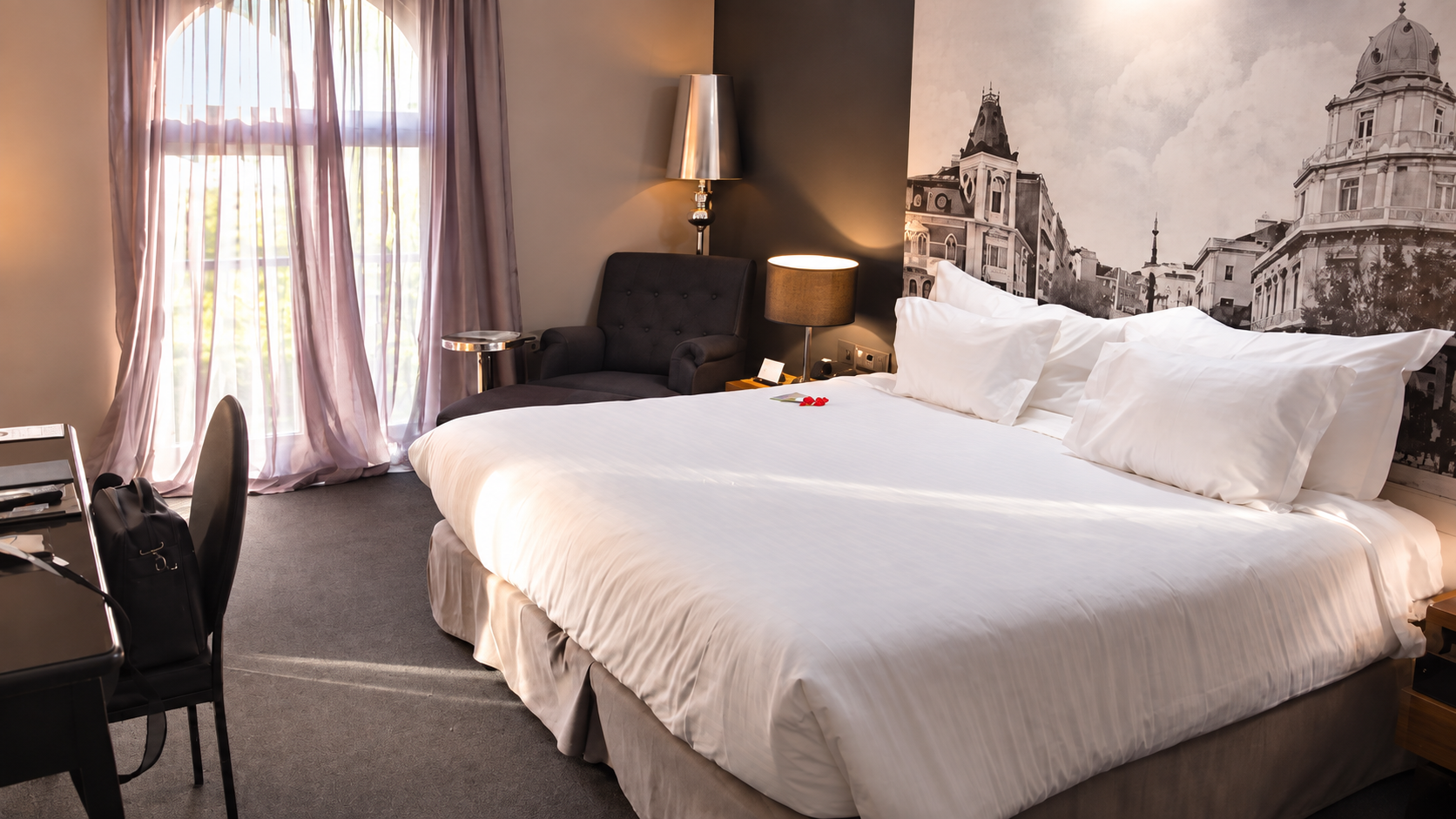
Dark corridors, a dramatic lobby and rooms that were, depending on which one you booked, almost entirely black or entirely white made it the complete opposite of Avenida Palace. If the Palace was saying, “Look how much history we have,” Fontecruz seemed to answer, “History is lovely — now let’s turn off the lights and do something completely different.” The design was excellent, unlike anything I had previously associated with a hotel.


Objectively, I did not need three hotels on one trip, but necessity had nothing to do with it. I was deliberately testing different hotel concepts and, within a few hundred metres, found three entirely different ideas of what a luxury hotel could be. On the same trip I also stayed in Évora and Porto, but that is another story.
2018 — Marriott and a few hours before Fes
I returned to Lisbon at the end of December 2018, but this time the city was not the final destination because I had a flight to Fes ahead of me. I stayed at the Lisbon Marriott Hotel, noticeably further from the historic centre than on my previous visit.
I was due to land in Lisbon from Venice that evening, but the flight was delayed so badly that I did not reach the hotel until around two in the morning. A sensible person would have slept as late as possible the next morning. I got up anyway and decided to walk all the way to the Tagus.
It was 28 December, a clear winter morning, and the walk from the Marriott to the river would take at least an hour. Fortunately, most of it was downhill.
I crossed Parque Eduardo VII, descended to Marquês de Pombal and continued along Avenida da Liberdade. Then something happened that could not have happened on my first visit: Lisbon turned into a map of my previous hotel rooms.

I passed Fontecruz, where I had already stayed and where I would stay again roughly a week later, after returning from Morocco. I continued towards Restauradores, where Altis Avenida and Avenida Palace were waiting. Suddenly I was no longer simply walking through the city, but past places where I had temporarily lived in it.
That may be my favourite part of that morning walk now. Three years after my first visit, Lisbon had already acquired points on the map where I could think: I once had a room here.
At some point along the way I came across what looked like a small pastel de nata factory. Since pastéis de nata are my favourite Portuguese pastry, the walk had to stop for a while. After only a few hours of sleep and several kilometres on foot, I had absolutely no intention of resisting fresh pastéis de nata.
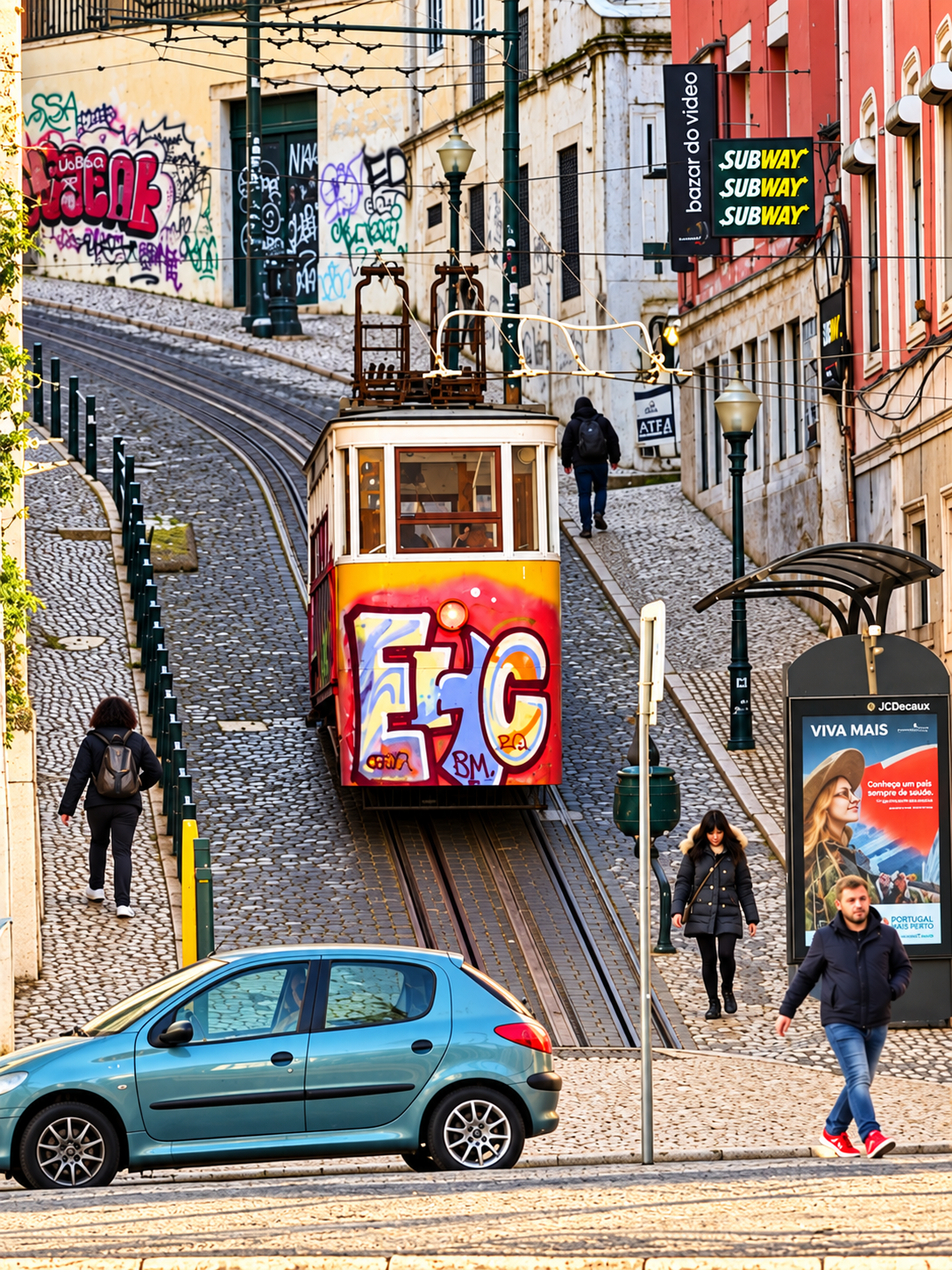
At Rossio I had planned to continue towards Rua Augusta, but then I saw one of those little yellow trams and the original plan immediately stopped mattering. I boarded the 12E and headed towards the steep streets of Alfama.

I have to admit that Alfama has never charmed me quite as much as almost every guidebook suggests it should. I cannot blame it on a single bad experience; it has never caught me in the way Lisbon apparently expects it to catch visitors. If I had to choose a neighbourhood in which to wander aimlessly, I would still pick Bairro Alto. The tram ride through Alfama, however, I would not trade.
I got off near Limoeiro and walked down towards the cathedral.
Sé: this time the doors were open
I had some unfinished business with Lisbon Cathedral. On previous visits, something had gone wrong every time: once I arrived when the doors were closed, another time there was a wedding, and on yet another occasion something else kept me outside. After several attempts, the whole thing had become slightly ridiculous.
That morning the doors were finally open, and I went in. It was hardly a major victory for humanity, but it was enough for me.


Then I looked at the time and realised it was no longer on my side. I hurried towards Praça do Comércio and the Tagus, walked beneath the arch into Rua Augusta, returned towards Rossio and caught a taxi back to the Marriott because, let me remind you, I still had a flight to Fes to catch.
That is why I barely associate my stay at the Marriott with the hotel itself. I remember it as the starting point for a morning in which I tried to squeeze one more Lisbon between a few hours of sleep and a flight to Morocco.
If you want the continuation, I Walked Through a Gate and Left the 21st Century Behind begins where this Lisbon morning ended.

2019 — back to Fontecruz
After Morocco I returned to Lisbon and stayed at Fontecruz again. There is something comforting about returning to a hotel you already know, especially after a journey on which you keep waking up somewhere different.
There are no first few minutes of orientation: you know where the lift is, what sort of space is waiting for you and where you are the moment you step outside. Fontecruz was no longer one of the hotels I had decided to try. It had become a hotel I returned to, which is a different kind of compliment.
The hotel organised a fado evening for me that remains one of my strongest memories of that trip. Dinner, however, consisted of torresmos — essentially Portugal’s version of pork cracklings. I am not sure I would have thought to pair fado and pork cracklings in the same evening, but Portugal clearly had no such problem.
Sold in 2022, the hotel reopened in 2023 as 138 Liberdade Hotel. Ownership, name, management and part of the concept changed, but the address stayed the same and the black-and-white rooms survived the transformation. It would have been a shame if the thing I remember most clearly about the hotel had disappeared.
2019 — ibis: the project had spoken
Later that same year I came to Lisbon again, this time for a project. The project had a budget, the budget had limits, and those limits were called ibis Lisboa José Malhoa.
After Avenida Palace, Altis, Fontecruz and the Marriott, it was an extremely efficient return to academic reality. The room was so small that my suitcase and I barely fitted inside; had I been sharing it with another traveller, I am not quite sure how either of us would have moved around. You could hear other guests at least two rooms away, so the whole thing had the feel of student halls.
That, to be fair, is a perfectly legitimate hotel philosophy. An ibis does not pretend to be a palace, and there is no reason to resent it for not being one. Then breakfast arrived and completely overturned that impression. It was generous, varied and better than in some hotels several categories above it, while an unlimited supply of pastéis de nata certainly did not hurt.
I am glad the ibis ended up on this list because without it the story would be too neat. It would look as though every visit to Lisbon involved trying to find an even better hotel. It did not. Sometimes I chose the hotel, and sometimes the budget chose it for me.
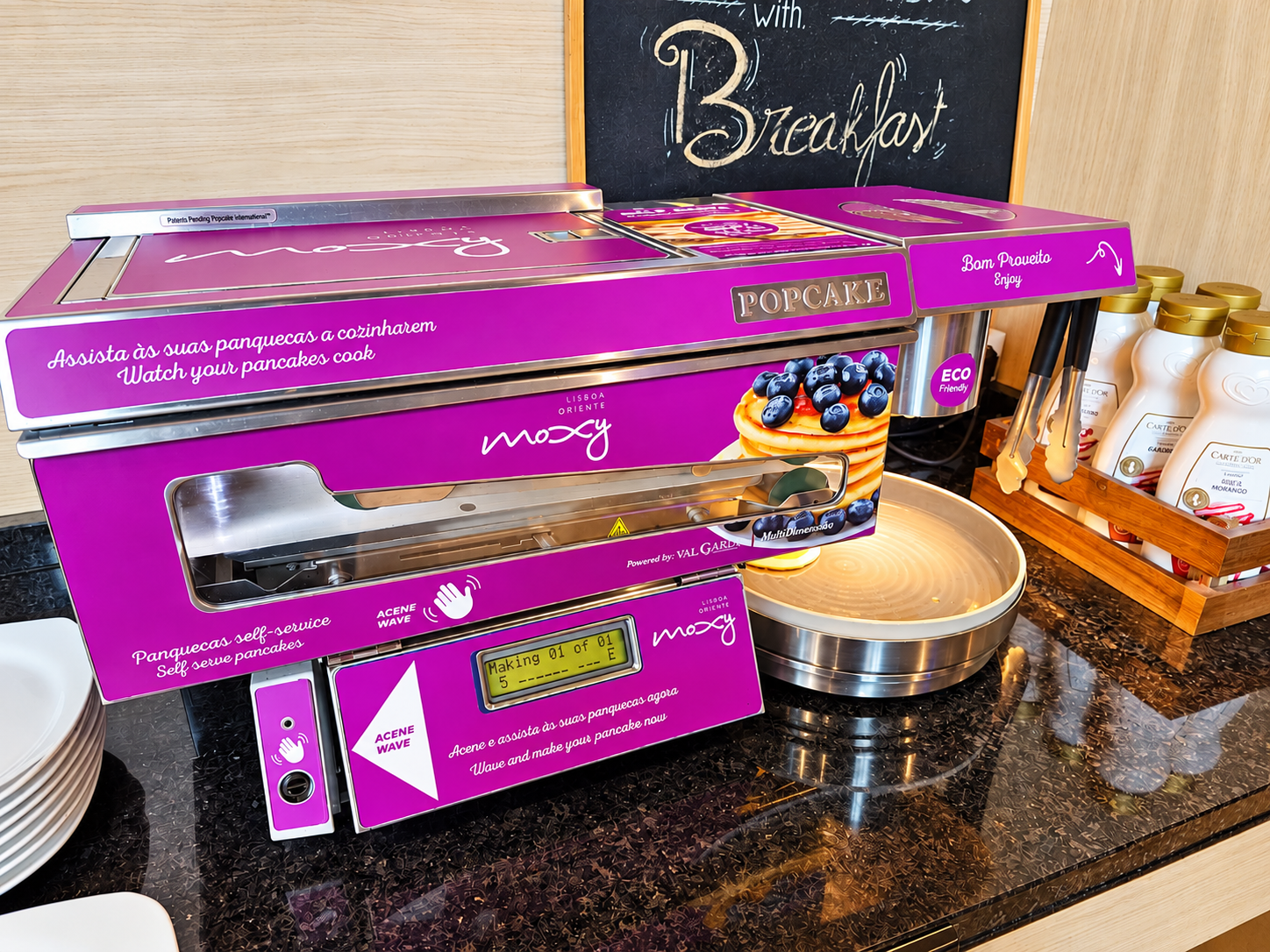
2024 — Moxy Oriente: good enough not to keep me inside
The last time I was in Lisbon was in 2024, nine years after Avenida Park. Again I was travelling for a conference, except that this time the conference was not in Lisbon but in Porto.
Lisbon was on the way. I needed one night before continuing north by train the following day, so Moxy Lisboa Oriente, next to Gare do Oriente, was an obvious choice.

Moxy hotels are basically the same wherever they appear. Walk into one in Lisbon, London’s Stratford or Bristol and you immediately recognise the formula: modern design, minimalism, informal service and ruthless functionality. It feels as if someone has teleported the hotel to a new address and merely changed the city outside the entrance.
That is what I like about them. They are modern and comfortable enough to make staying there enjoyable, but not so luxurious that their own beauty persuades me to remain inside. When I travel, that is a genuine advantage.
In Lisbon in 2024, it was exactly what I needed. I was not looking for rooftop breakfast or a historic salon, only one night, good transport links and an easy continuation to Porto. Gare do Oriente was practically outside the door, and the hotel did precisely what I had chosen it to do.
Seven rooms later
When I booked the conference-recommended hotel in 2015, I had no idea I was beginning a sequence that would last almost a decade. Since then the reasons for coming have changed, the way I travel has changed, budgets have changed, and so have my expectations of hotels, while one city has kept returning throughout it all.
That is why asking which of the seven hotels was the best does not make much sense. Avenida Palace could not have been Moxy, Moxy did not need to be Avenida Palace, and the ibis in 2019 had no reason to try to be Fontecruz. Each belonged to a different trip and to a different version of me arriving in Lisbon at the time. The hotels kept a remarkably tidy record of the changes.
How other guests see them today
Out of curiosity, I checked how these seven hotels are rated today. The Booking scores below were checked on 14 September 2026 and should be read as a snapshot of a particular moment, because new reviews will inevitably change them.
| Hotel | overall | location |
|---|---|---|
| Avenida Park | 8.8 | 9.4 |
| Altis Avenida | 9.3 | 9.9 |
| Avenida Palace | 9.4 | 9.8 |
| 138 Liberdade Hotel, formerly Fontecruz | 9.1 | 9.7 |
| Lisbon Marriott | 8.1 | 8.1 |
| ibis Lisboa José Malhoa | 8.1 | 8.4 |
| Moxy Lisboa Oriente | 8.9 | 9.5 |
The numbers actually explain my memories rather well. Altis Avenida and Avenida Palace still benefit enormously from their locations, while the former Fontecruz remains a highly rated combination of design and Avenida da Liberdade. Avenida Park confirms what I thought about it back in 2015 — practicality is a stronger card than personality. Lisbon Marriott remains a good hotel whose location is not its main selling point, ibis does what people choose it for, and Moxy’s location score makes perfect sense for a hotel I chose because I had a train from Oriente the next morning.
But the numbers do not know the interesting part. They do not know that Altis cost less than one hundred euros, that the doorman took my shopping bags upstairs while I carried on wandering through the city, that Avenida Palace served croissants Paris itself would have been proud of, that a project sent me into a room where my suitcase and I could barely fit, or that after arriving at the Marriott at around two in the morning I still got up and walked towards the Tagus.
A little more Lisbon, for the curious
In the main story, Lisbon appears mostly as the space between hotel rooms. Some of the places I passed through over those years, however, deserve a little more context. This is not another version of the same walk, but a handful of details I researched at the time and do not want to lose.
The park, the marquis and the lion
Parque Eduardo VII is a broad green space descending towards Marquês de Pombal. From its upper end, one of Lisbon’s most recognisable views opens up: the geometry of the park, the monument to the marquis, Avenida da Liberdade and, in the distance, the Tagus. Its present central layout is associated with Keil do Amaral’s work in the 1940s.
Originally known as Parque da Liberdade, the park was renamed in 1903 following the visit of Britain’s King Edward VII. It also contains Estufa Fria, one of Lisbon’s best-known gardens, sheltered beneath a latticed roof. At the lower end of the park lies Marquês de Pombal, one of the city’s major transport junctions.

Sebastião José de Carvalho e Melo, the Marquis of Pombal, became inseparably associated with the rebuilding of Lisbon after the catastrophic earthquake of 1755. From the top of the monument he looks towards the city whose reconstruction he oversaw, with a lion beside him as a symbol of power.
Lisbon’s Champs-Élysées
From Marquês de Pombal towards the centre runs Avenida da Liberdade. In an older piece I called it Lisbon’s Champs-Élysées, and I still think the comparison works rather well, although Lisbon, fortunately, never tried to create a copy of Paris.
It is broad, green and lined with hotels, fountains and luxury boutiques. Instead of Parisian pavements, it has the characteristic Portuguese calçada — black-and-white stone mosaic paving that has become one of Lisbon’s visual signatures. Avenida da Liberdade remains the city’s main address for international luxury brands, which helps explain why the location of the former Fontecruz was always one of its greatest strengths.

Restauradores, Glória and a date that became a street
The name Praça dos Restauradores refers to the restoration of Portuguese independence in 1640, after sixty years during which Portugal and Spain shared Habsburg monarchs. In the centre of the square stands a monumental obelisk dedicated to the Restoration, with bronze figures representing Victory and Independence.
Nearby begins Ascensor da Glória, the historic funicular that linked Restauradores with Bairro Alto from 1885 until 3 September 2025, when one of its cars derailed and crashed, killing 16 people. It has been closed ever since, and Carris, Lisbon's public transport operator, runs the 51E as a replacement service.
The street running from Restauradores towards Rossio is called Rua 1.º de Dezembro, after 1 December 1640, the date of the Portuguese Restoration. In a very small area, the same historical event therefore appears in the name of the square, the monument and the street itself. Altis Avenida and Avenida Palace stand opposite one another on this very stretch.
Rossio: square, emperor and railway station
Construction of Rossio railway station began in 1886, and it opened in 1890. At the time it was known as Estação da Avenida or Estação Central, and the words Estação Central can still be read on its façade. For many years it served as Lisbon’s principal central railway terminal; today it is primarily the city-centre departure point for trains towards Sintra.

In front of the station is Praça Dom Pedro IV, although practically everyone calls it Rossio. Since 1870, a column topped by a statue of Pedro IV has stood in the middle of the square. He was king of Portugal and, as Pedro I, the first emperor of independent Brazil. At the base are allegorical figures of Justice, Prudence, Strength and Temperance; two monumental fountains stand on either side of the square, while the National Theatre D. Maria II occupies its northern side. The ground is covered in the famous wave pattern of Portuguese calçada.
Alfama, fado and saudade
Alfama is the oldest part of Lisbon, a maze of narrow streets and steep passages descending from the slopes beneath Castelo de São Jorge. Historically, it has been strongly associated with sailors, working-class communities and the development of fado.
It is difficult to write about fado without the word saudade. Translating it as “longing” or “nostalgia” comes close, but never quite captures it. The word contains absence, desire, memory and a certain acceptance that what is longed for may never return.
That is one reason Alfama has become an almost compulsory part of the tourist image of Lisbon.
The earthquake that changed the city
The earthquake of 1 November 1755 did more than destroy much of Lisbon; it decisively shaped the appearance of the city centre we see today. The earthquake was followed by fires and a tsunami, and then by a vast programme of reconstruction under the Marquis of Pombal.
This is most obvious in the Baixa, the carefully organised lower city with its grid of straight streets. On the site of the former royal palace, Paço da Ribeira, destroyed in the catastrophe, the monumental Praça do Comércio was created, opening towards the Tagus. Because of the palace that once stood there, Lisbon residents still often call the square Terreiro do Paço.
At its centre stands the equestrian statue of King José I, erected in 1775. Facing the city is the Arco da Rua Augusta, conceived as part of the post-earthquake reconstruction but only completed in 1875. That difference in dates is a useful reminder that rebuilding Lisbon was a long process rather than a single burst of construction immediately after the disaster.
The bridge that changed its name
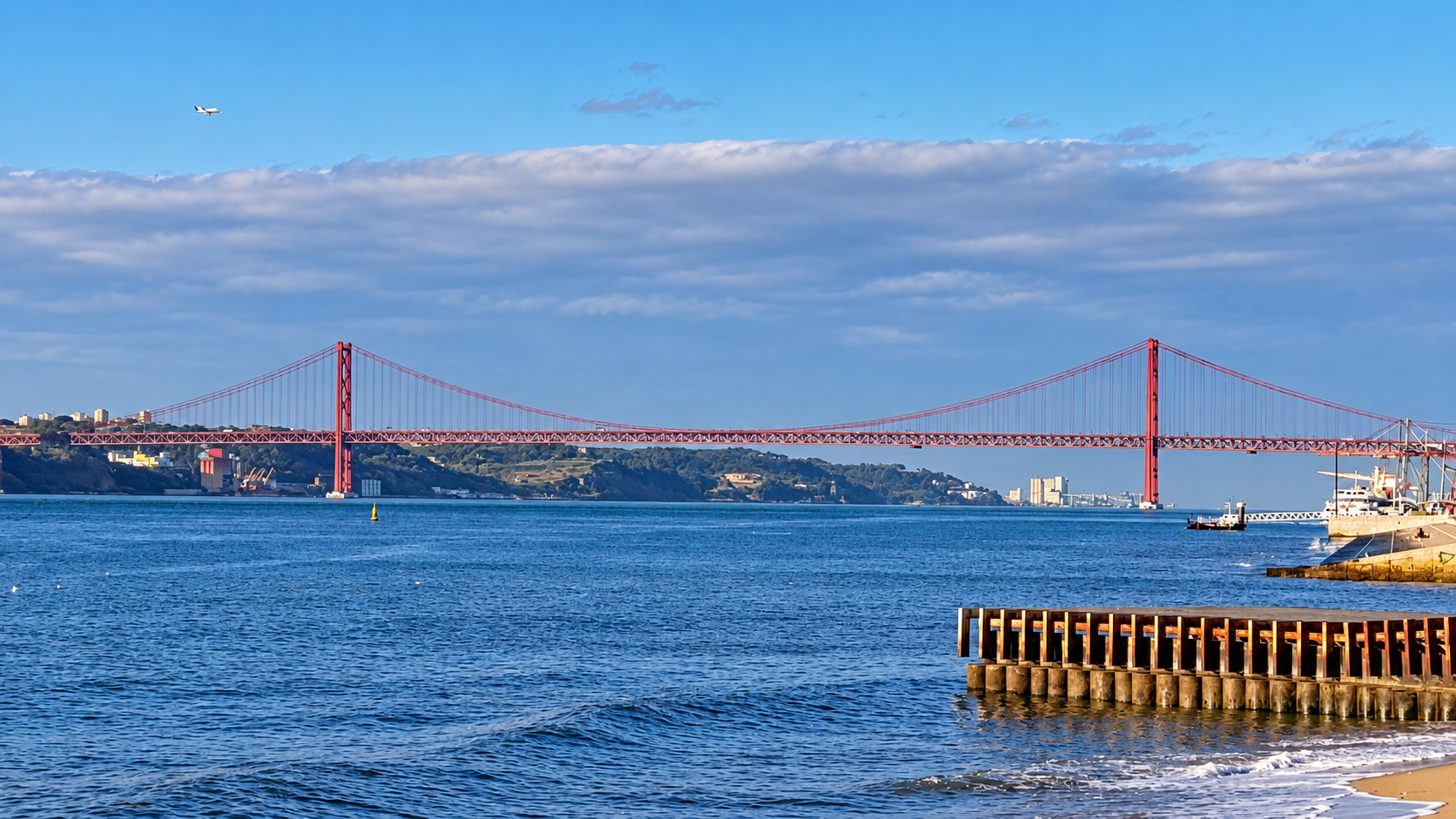
From Praça do Comércio and other points along the Tagus, it is difficult to miss Ponte 25 de Abril, the steel suspension bridge whose resemblance to the Golden Gate is usually the first thing visitors notice.
The bridge opened on 6 August 1966 as Ponte Salazar, named after Portugal’s authoritarian leader António de Oliveira Salazar. After the Carnation Revolution of 25 April 1974, the Salazar name was removed and the bridge became Ponte 25 de Abril.
The revolution opened the way to Portuguese democracy, the end of the colonial wars and rapid decolonisation. Portugal formally recognised Guinea-Bissau’s independence in 1974; Mozambique, Cape Verde, São Tomé and Príncipe, and Angola became independent in 1975.